The Purchasing Power of $40T of Debt
US Treasury Secretary Scott Bessent would like for people to just calm it down a bit

I subverted the invasion of an intergalactic tyrant, but Stuff still Happened.
So, what's up?
It's the Stupid Economy
Some Americans are finding this economy to be just excellent, such as Donald Trump and his family who have made billions during his presidency. Others, such as the several hundred million other people in this country, are finding things to be a tad unaffordable.
Don't worry—I've got all the info you need to start fixing your financial life and get back on track. The stuff you're really concerned about is what the government is focused on the most: stocks and bonds!
…which… don't really apply to the vast majority of the everyday affordability problems right now
…and… it's this administration, which tends to turn "working on it" into "absolutely annihilating it," and Treasury Secretary Scott Bessent is truly working on it.
Let's start with the context: the US economy is in a real messed up spot. Beyond the AI bubble speculation, we're in yet another endless war with the added bonus of fucking up international oil trade. Recently, a Saudi oil pipeline pumping station was struck by Iranian-backed militias in Iraq, which takes a critical oil pipeline out of play; one of the few things keeping oil moving while the Strait of Hormuz remains deadlocked from the Iran war.
All the while, the bond markets have been having a helluva time. Now, I want to be clear: I am not a financial analyst, advisor, or economy boy. If you want actual economic analysis, I highly recommend Kyla Scanlon's work. But this is Stuff Keeps Happening, so we'll review this SKH-style.
Scott Bessent is a dumbass.
My first supporting evidence: he decided to join ranks with the Trump administration—a questionable decision for anyone, especially a gay man. But hey, he's now the highest ranking openly gay official in US history, so get it I guess.
Anyway, this dumbass took his dumb ass and went up to a podium and announced that the US Treasury would double—going on to triple—a bond buyback effort to stabilize the long-term bond market during a time of intense instability and selloffs.
(Hey, join me in these parenthesis for a moment. I do not expect everyone reading this to know what "long-term bonds" and "short-term bonds" even mean. In fact, I would prefer a world where most people didn't have to care about that. But for our purposes, we will define "bonds" as "loans given TO the government from external buyers who expect the government to pay back with interest")
Long term bonds generally show investor faith in the long-term ability of a government to actually pay back the loan with interest. When we see people selling off bonds, the market floods and causes prices to drop and yields to rise. In simple terms, people aren't as willing to spot the government some cash to cover the massive pile of debt we have.
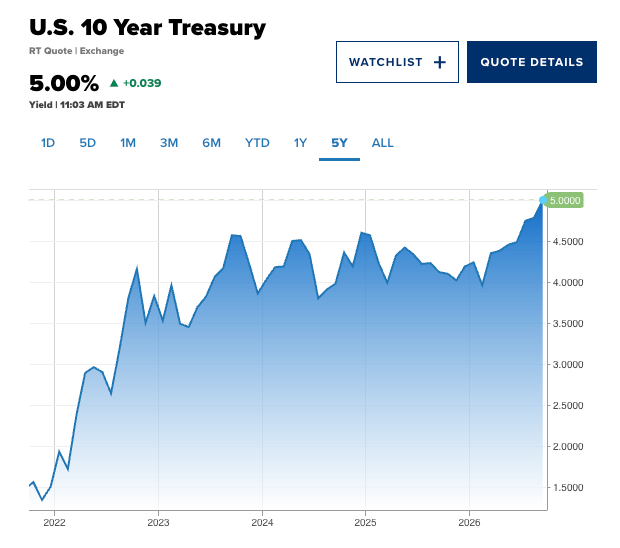
So again, Bessent saw the state of things, told a global stage of investors that the US would fix it by sizably increasing efforts to buy back bonds to fix the flood, only for the problem to continue trending worse, with the 10-year bond yield hitting 5% for the first time since October 2023, where it had briefly crossed 5% before coming back down.
All the while, oil scarcity drives gas and diesel prices up, with diesel having an outsized impact on the US economy. We lean heavily on trucking for just about everything.
Of course, we should all ignore this and instead gawk at the DOW, which is over 50,000, of course, of course.
Famously, the bond market imploding has no impact on stocks. (It does.)
Blizzard Unionization
Activision Blizzard workers recently landed a union contract after two years of negotiations, extending union benefits to about 1,900 employees.
Activision Blizzard's parent company is Microsoft / Xbox, which has been on a helluva layoff tear these past few years, dumping even successful studio talent in a part of a larger gaming industry bloodbath.
Previously, a union contract for QA workers landed at the Very Cold Game Developer, but as of this past week a contract with CWA brought with it more coverage and industry-first benefits.
In addition to better wages, the union won:
- The right to be "recalled" into a position up to 14 months after a layoff, should the company realize they need to rehire
- Increased severance pay across the board
- A provision requiring negotiation from the company with regards to the use of AI
- Hybrid work schedule
- Disability accommodations
- …and a bunch of smaller line items
The contract negotiation taking literal years is not super surprising. Activision Blizzard attempted to undermine a QA worker unionization vote back in 2022. In 2023, the National Labor Relations Board found merit on charges against Blizzard over "illegal coercion, intimidation, and silencing" regarding the unionization efforts.
As the gaming and tech industry continue to go through a hard transformation from "nascent field" into "legacy industry," we'll continue to see more of this. Workers once believed—to some degree—the whole "we'd rather work directly with our employees!" mantra from these giant tech companies because hey, there's free snacks and a pool table at the office. Fast forward to 2026, and that pizza party will be costing you two additional late evenings.
If it takes union efforts to secure at least 2 slices of pizza, the scales are outta wack.
California's Tech Law Flurry
The United States are pretty far from united on many fronts. One of the newer misalignments has been "what the fuck do we do about tech policy?"
It should be obvious to anyone who has so much as breathed in the United States of America that our federal policy makers are far from up to the challenge of crafting meaningful tech policy. Meanwhile, individual states (and honestly, Governors hopeful for a shot at POTUS) take it upon themselves to push policy in an attempt to set a precedent, leading to a mosaic of tech laws across more than fifty jurisdictions in a trench coat.
Last week, California governor and obvious 2028 hopeful Gavin Newsom signed a flurry of tech and AI regulation bills into law. The contents of these policies range from "yeah that makes sense" to "hey, so, what the fuck?" as is divine law regarding American tech policy. Among some of them:
- AB 1946 strengthens reporting of child exploitation material and the consequences for inaction from companies
- AB 2 strengthens the legal basis for suing a social media company over harm to children
- AB 2071 mandates "digital wellness" to be taught in health classes in school
Like, aight, makes sense. Then we get to the more controversial ones:
- AB 1856 is an amendment to the 2025 Digital Age Assurance Act, making a carve-out for open source projects (good!) while leaving in the requirement for operating systems to report user age demographic information to apps (not good!)
- AB 1709 functionally establishes a minimum age requirement for social media apps, requiring that users under 16 not be exposed to "addictive features" such as infinite scrolling or video autoplay (can I opt-in to being treated as a 15 year old, please?)
Personally, I do think we need a major upheaval in the structure of social media platforms—especially as they relate to children and teenagers. I don't think "block them entirely" is the right call, and I have major doubts that tech companies will approach these restrictions in good faith.
An Ocean of Fire
(Author's note [it's still me, I'm the only author here]: the sun is not technically fire, but is instead a large chemical reaction. Don't send me to science jail, thanks.)
How do you feel about Kelvin-Helmholtz instability? I bet you have very strong opinions. For the other folks in the room who may be unfamiliar with Kelvin-Helmholtz instability, it's basically a fluid physics phenomenon where fluids of differing velocity cause each other to get all swirly. It happens in atmospheres and can be visualized by clouds sometimes:

It also plays a big role in ocean mixing, or at least, that's what the Official Magazine of the Oceanography Society's website says, and I would trust them with my life regarding most things Kelvin-Helmholtz.
So why am I talking about this? Well, the Sun. You've heard of it. It's up in the sky most days, and sometimes it goes dark because the moon gets a bit pushy. But mostly, it makes plants happy. And now, we know it, too, has Kelvin-Helmholtz instability (KHI) opinions.

Using a wildly sensitive solar telescope on an island in Hawaii, researchers have captured the highest resolution image of the surface of the Sun ever, revealing those good good swirlies that we see from KHI. The prevailing theory is that this is brought upon our great ball of fire from the wild magnetic fields which act like currents in the truly difficult-to-comprehend madness that is a star. "Flux braiding," they call it, which genuinely sounds like an ability from Mass Effect. So, good on 'em.
Here's the Weather

More Stuff
- There has been a series of beaver attacks in state parks in Maryland, in what I have to assume is a viral marketing stunt for a return of the animated show Angry Beavers
- Google is attempting to purchase a massive chunk of operational data from now-defunct Spirit Airlines
- Mitch McConnell is apparently alive after all, but barely. He returned to the senate floor this week on a wheelchair pushed by staffers, seeming quite unaware of his surroundings
- Apple has released iOS and macOS 27, releasing their updated Siri to the world after years of Siri being an absolute joke of a feature
- An armadillo was found in Ohio, the first ever recorded to naturally migrate there. It was dead when they found it, but I do want to quote a university professor from the area who, per the article, said, "I was hoping they were going to make it here, simply because I like armadillos." Very fair.
- Hugo, the world's tallest horse, stands at 6'5" (199cm) and is still growing because he is a big boy and that's what big boy do