Palantir Cannot See Why Kids Love the Taste of Cinnamon Toast Crunch
Despite their penchant for building surveillance software, Palantir CEO Alex Karp is reportedly unaware of the cinnamon-sugar swirls in every bite.

So About Palantir…
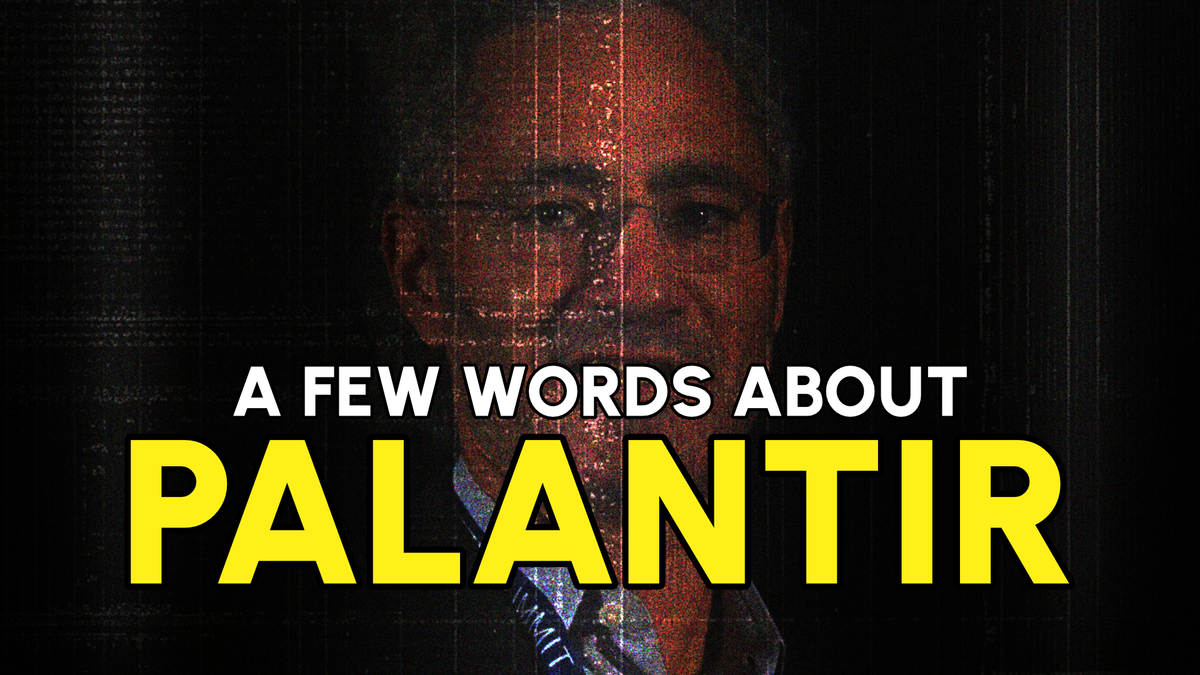
Palantir is in the news. What the fuck is Palantir? I wish you didn't need to know.
Palantir is a US tech company focused near-exclusively on militarized intelligence. It was founded by Peter Thiel, Alex Karp and a few others with initial funding from—I shit you not—the CIA.
There's this thing called In-Q-Tel which is a US taxpayer funded venture capital firm whose sole purpose is to invest in tech companies for the benefit of the CIA. From the drop, Palantir was purpose-built to make technologies which empower the US government to conduct surveillance. Like, that's just… their stated mission.
But then they decided over the weekend to take to Twitter and post a 22-point "summary" of a book co-authored by Alex Karp, the wiry-haired, unhinged CEO of Palantir.
These 22 points boil down to, "we firmly believe that democracy is not worth it, we should bring back the draft, multiculturalism is a plague, and billionaires are fundamentally better than you."
Read the full 22-point post
- Silicon Valley owes a moral debt to the country that made its rise possible. The engineering elite of Silicon Valley has an affirmative obligation to participate in the defense of the nation.
- We must rebel against the tyranny of the apps. Is the iPhone our greatest creative if not crowning achievement as a civilization? The object has changed our lives, but it may also now be limiting and constraining our sense of the possible.
- Free email is not enough. The decadence of a culture or civilization, and indeed its ruling class, will be forgiven only if that culture is capable of delivering economic growth and security for the public.
- The limits of soft power, of soaring rhetoric alone, have been exposed. The ability of free and democratic societies to prevail requires something more than moral appeal. It requires hard power, and hard power in this century will be built on software.
- The question is not whether A.I. weapons will be built; it is who will build them and for what purpose. Our adversaries will not pause to indulge in theatrical debates about the merits of developing technologies with critical military and national security applications. They will proceed.
- National service should be a universal duty. We should, as a society, seriously consider moving away from an all-volunteer force and only fight the next war if everyone shares in the risk and the cost.
- If a U.S. Marine asks for a better rifle, we should build it; and the same goes for software. We should as a country be capable of continuing a debate about the appropriateness of military action abroad while remaining unflinching in our commitment to those we have asked to step into harm's way.
- Public servants need not be our priests. Any business that compensated its employees in the way that the federal government compensates public servants would struggle to survive.
- We should show far more grace towards those who have subjected themselves to public life. The eradication of any space for forgiveness—a jettisoning of any tolerance for the complexities and contradictions of the human psyche—may leave us with a cast of characters at the helm we will grow to regret.
- The psychologization of modern politics is leading us astray. Those who look to the political arena to nourish their soul and sense of self, who rely too heavily on their internal life finding expression in people they may never meet, will be left disappointed.
- Our society has grown too eager to hasten, and is often gleeful at, the demise of its enemies. The vanquishing of an opponent is a moment to pause, not rejoice.
- The atomic age is ending. One age of deterrence, the atomic age, is ending, and a new era of deterrence built on A.I. is set to begin.
- No other country in the history of the world has advanced progressive values more than this one. The United States is far from perfect. But it is easy to forget how much more opportunity exists in this country for those who are not hereditary elites than in any other nation on the planet.
- American power has made possible an extraordinarily long peace. Too many have forgotten or perhaps take for granted that nearly a century of some version of peace has prevailed in the world without a great power military conflict. At least three generations—billions of people and their children and now grandchildren—have never known a world war.
- The postwar neutering of Germany and Japan must be undone. The defanging of Germany was an overcorrection for which Europe is now paying a heavy price. A similar and highly theatrical commitment to Japanese pacifism will, if maintained, also threaten to shift the balance of power in Asia.
- We should applaud those who attempt to build where the market has failed to act. The culture almost snickers at Musk's interest in grand narrative, as if billionaires ought to simply stay in their lane of enriching themselves … . Any curiosity or genuine interest in the value of what he has created is essentially dismissed, or perhaps lurks from beneath a thinly veiled scorn.
- Silicon Valley must play a role in addressing violent crime. Many politicians across the United States have essentially shrugged when it comes to violent crime, abandoning any serious efforts to address the problem or take on any risk with their constituencies or donors in coming up with solutions and experiments in what should be a desperate bid to save lives.
- The ruthless exposure of the private lives of public figures drives far too much talent away from government service. The public arena—and the shallow and petty assaults against those who dare to do something other than enrich themselves—has become so unforgiving that the republic is left with a significant roster of ineffectual, empty vessels whose ambition one would forgive if there were any genuine belief structure lurking within.
- The caution in public life that we unwittingly encourage is corrosive. Those who say nothing wrong often say nothing much at all.
- The pervasive intolerance of religious belief in certain circles must be resisted. The elite's intolerance of religious belief is perhaps one of the most telling signs that its political project constitutes a less open intellectual movement than many within it would claim.
- Some cultures have produced vital advances; others remain dysfunctional and regressive. All cultures are now equal. Criticism and value judgments are forbidden. Yet this new dogma glosses over the fact that certain cultures and indeed subcultures … have produced wonders. Others have proven middling, and worse, regressive and harmful.
- We must resist the shallow temptation of a vacant and hollow pluralism. We, in America and more broadly the West, have for the past half century resisted defining national cultures in the name of inclusivity. But inclusion into what?
The response has been pointed, thankfully. Cheyenne MacDonald at Engadget called it a manifesto that reads like "ramblings of a comic book villain." Palantir stock dropped, and foreign government representatives are publicly questioning if they should drop Palantir contracts.
AYUP. I'D SAY SO.
This company has billions upon billions of dollars worth of contracts with the US military. It is a darling of the intelligence community. Their flagship product is a system that glues together information from various databases across governmental agencies to track, monitor, and hunt down whoever they want. Alex Karp himself keeps enthusiastically talking about how good Palantir is at killing people, or at least helping to kill people!
Look, I am not a fool. I know that militarized intelligence, military readiness, surveillance and whatnot are all just facts of reality. They aren't going to disappear. Palantir is just a company that unapologetically capitalizes on that. It's a true "don't hate the player, hate the game" moment.
But no—I can hate the player when the player is modifying the game for their benefit. Peter Thiel essentially installed JD Vance as vice president with Trump, and Palantir became a forefront contractor for Trump's agenda. It's not a matter of being a patriotic company who wishes to defend their nation. This company is bragging about their unparalleled ability to spy while publicly signaling their desire to subjugate the populace while also having direct influence over public office as a corporation who—again—was essentially founded by the CIA through taxpayer funds.
The silver lining here is that pretty much everyone hates Palantir, and this hasn't helped their case. I guess I should say, "pretty much everyone who isn't actively participating in an authoritarian regime hates Palantir," for accuracy.
Keep showing your ass, Karp. I look forward to your trial.
EU Battery Passports
Digital regulation is a hot issue in 2026, what with all the attempts to require people to verify their age to use basic functionality because we must save the children.
But while a good chunk of regulation is flatly cynical, there's still glints of genuinely interesting policy, even if it's not fully there yet.
Over in the EU, electronics and auto industry workers are getting a vibe for a new regulation set to land in 2027: "Battery Passports."
The idea is this: for each Big Ol' Battery, there must be a QR code someone can scan to pull up a report about that battery's sourcing, manufacturing, and history. The goal is to reduce battery waste and increase reusability and transparency of supply chains. It's like a "Nutritional Facts" label for batteries.
Lemme clarify real quick: this does not apply to your phone's battery. Nor does it apply to your laptop, e-reader, etc. It would apply to your e-bike or personal transportation device, but it's really meant for the Big Boy Batteries at this time.
Okay, but how Tho?
On my first read of this, I was left with a burning question: "how?"
Is there a central database of all this information? Who is collecting it? Who is verifying it? How is it stored? Dear god; please don't tell me this is some blockchain bullshit.
The answer is no, it is not some blockchain bullshit. That is because it is not really any bullshit right now. The implementation details are just not there yet.
What we know is that manufacturers, importers, resellers, and merchants must partake in keeping the information updated as the battery is passed around or modified. As for where that data will be stored? Uh, that's a bit of a TBD. Which is concerning since this is supposed to start mattering literally next year.
That said, while the technical details aren't there, the legal details are. Whatever the technical implementation, the requirements are:
- A user must be able to scan a QR code to pull up the information
- There are three "privacy levels" of information:
- Public information, like the battery's manufacturer or chemistry
- Protected information, like battery health or charge cycle count
- Regulatory information, like supply chain info
- No matter the manufacturer, there must be interoperability on the passport information to allow for the battery to change hands
So is this… Good?
Unclear. Maybe! I really dig the idea of crafting policy that requires more transparency for consumers as well as transparency for supply chains. I also like that the requirements include interoperability and ease of access. In theory, were this commonplace already, you would have access to audited information about a battery when making a purchase. Imagine being able to ignore marketing statements altogether and just get the actual information about the product!
On the other hand, there's a lot of potential for issues. Of course without knowing the technical details, it's hard to say what'll happen specifically, but we don't need to look far to find another EU digital policy that near-instantly had a security issue.
A recently announced app from the EU whose purpose is age verification was exploited in minutes, with security researchers noting that it's a matter of when, not if this app is the source of a massive security breach.
So no, unfortunately you can't just make regulation that seems reasonable and expect it to translate to functional technical details. Sure, it makes sense on the surface that a for-profit company engaging in adult-regulated business practices should have to verify the age of their users. If you go to a club, they check your ID. Makes sense! But uh, there's a bit of a difference between Jeremy Bouncer at some club down the street checking your ID and Sam Altman feeding your identification and personal history into his false statements machine.
It is my genuine hope that when we see more info about Battery Passports, that it'll be a fairly reasonable implementation. I've got my doubts. But if it works, I do think it would be better for not just the consumer but the planet at large.
The Forest for the Trees
In late March of this year, the Trump administration began a near-complete dismantling of the United States Forest Service. This comes just in time for wildfire season, which is already looking to be a record-setting season. 1.62 million acres of land has already burned this year, which is more than double the year-to-date average over the past decade.
In a move ostensibly meant to seem like a pivot towards "efficiency," the Trump admin ordered the following changes to the US Forest Service:
- Move the headquarters from Washington DC to Utah
- Close ALL regional offices
- Close nearly all research locations spread around the country
Of these changes, you might be wondering, "why Utah?" The answer is as cynical as you might think: Utah is ground zero for sniping public lands for private industry. Utah's governor and senators are well known for cozying up to the mining and lumber industries, and this is a huge slam dunk for them.
I should mention that the White House has indeed spun up a new department whose listed purpose is to focus entirely on wild land firefighting called the "Wildland Fire Service" as a part of the Department of the Interior. Congress hasn't funded the department, so it is already underfunded, understaffed, and sitting with an uncertain future while the existing experts are out.
If you live in an area prone to wildfires—or even if not, please take extra precautions this year and be sure to have an emergency plan in place.
Funk Sole Brother
I hope that your feet had artificial intelligence ambitions, because that's the only way this is gonna work.
Shoe company Allbirds is no more. Well, kinda. They still exist, but recently announced a pivot from being an environmentally conscious shoe brand to an artificial intelligence infrastructure leasing firm.
Allbirds was a Silicon Valley darling in its own way. While most Silicon Valley darlings are tech startups positioned for high yield investments, Allbirds was a darling because the shoes were comfortable. That, and they just kinda became an in-statement. If you were a tech bro in Silicon Valley, you probably had a pair of Allbirds.
The company ostensibly focused on sustainable practices as noted on their likely-to-eventually-be-defunct sustainable practices webpage. They even bragged about being a B Corp with a public good commitment.
So anyway, they aren't doing any of that anymore.
Allbirds went public in November of 2021 under the ticker symbol, "BIRD." They closed at a bit under $30/share on their first day on the stock market. A few years later, BIRD was trading at less than $3/share.
It's not typically good when you lose trailing zeroes on your stock price.
So the company was kaput, basically. Well, sorta. "BIRD" is a shell listing. It can separate from the Allbirds brand without dropping from the stock market. It holds value for simply being a purchasable security on the market.
So since the shoe business went kerblamo, why the hell not pivot to AI infrastructure? Eh? EHHH?
After the announcement of their pivot to AI, BIRD prices jumped back into double digits, though I don't think any financial planner will be recommending that you invest in BIRD right now.
The company will now be named, "NewBird AI," and interestingly enough, they need to get shareholder approval for this plan, since pivoting from sustainability to the destroy-the-earth-for-profit-machine industry is a bit of a change. Fortunately for them, the people with Allbirds on their feet (and, likely, in their portfolio) are probably fine with it.
Here's the Weather

More Stuff
- Virginia has become the latest state to enter the "redistricting wars" after Texas changed their congressional map to favor additional Republican house seats in the 2026 midterms
- Kash Patel is suing The Atlantic after the Atlantic published an article detailing Patel's reported on-the-job drinking. He seems to think this is a good idea that will go well for him, and I'm just so happy for that for him.
- Microsoft is reportedly planning some changes to Game Pass pricing as the new Xbox CEO feels the value proposition is busted
- After California coffee chain Philz announced a new policy requiring pride flags to be removed from stores, the backlash was swift enough that they reversed course in like a week.
- You are a coffee chain in California during a period of incredible pain inflicted upon queer communities daily. The fuck did you think was gonna happen?
- A United Airlines flight from Chicago to New York did an emergency landing due to a bomb threat. The bomb squad did not find a bomb.
- Fewer people are moving to Florida while more folks are moving out due to affordability issues. While there has been a spike in wealthy residents moving there, a larger portion of average folks are choosing to seek opportunity elsewhere.
- An otter made its way into a garden center in Scotland where it made itself at home for a bit before some local veterinarians came by to help the lil dude out. Or rather, ruin his new digs.