Good Still Happens
There has been an endless stream of cosmic horrors plaguing the news cycle for quite some time, and the balance has gotten very outta wack. In today's Stuff Keeps Happening, we take a look at a very bits of pretty good Stuff.


Hello, dear reader.
Over the past few months the ratio of cosmic-horrors-to-decently-uplifting-stories has been fully out of wack for this here newsletter. Well, and the world.
Given that it's a short holiday week stateside, and given that I would like to not find myself in the depths of despair this week, I thought it'd be nice to take some time and put together a pretty-good-stuff only issue of Stuff Keeps Happening.
Might get a bit shaky sometimes, but I promise that most of the stuff here is Actually Kinda Rad.
There is a LOT out there right now that is truly heartbreaking. And also, sometimes we need to remember that bad news feels global while good news feels fleeting. That is not the case, and losing sight of the incredible good that comes from most humans lets the awful ones have all the power.
So with that said, I would like to talk about your cervix.
Welcome to the Cervix Party
Approximately every two minutes, a human being dies of cervical cancer somewhere on planet Earth. That may not sound like good news—because it isn't. Sorry to zag on you like that.
Here's the actual upshot: we're watching a global revolution against cervical cancer. It's to the point that we may start seeing countries eliminate cervical cancer in the not-too-distant future.
Australia projects the elimination of cervical cancer in the country by 2035. A recent study in England found that there were exactly zero deaths among women aged 20-24 between the years of… oh, 2020 and 2024. A five-year span with zero deaths of a demographic typically blindsided by cervical cancer. Had trends continued as expected, there would have been a little over 20 deaths from cervical cancer for that demographic.
Other countries have seen reductions as well, mostly thanks to the advent and circulation of the HPV vaccine.
HPV—Human papillomavirus—is a virus with a bajillion variants, many of which can progress into cancer. It is the most common sexually transmitted infection in the United States, seeing around 14 million infections each year.
It's actually so viral and common that if you haven't gotten an HPV vaccine and you are sexually active with varying partners, it is more likely than not that you'll get it at some point. Many folks—especially men—don't even know they have it and unknowingly pass it on to another partner.
Given the relative invisibility of HPV, it is recommended that everyone get the HPV vaccine, even if you don't have a cervix with which to be cancer'd. And as we've seen from above, the HPV vaccine has absolutely body-slammed cervical cancer rates in women; one of the most common and deadliest cancers around.
Cervix or not, I encourage you to talk to your doctor about an HPV vaccine if you don't think you've gotten one yet. You're either helping yourself or helping those you quite literally love dearest.
Signed,
The son of a gynecological nurse who for years told everyone to get the HPV vaccine even if they were boys only to be hella vindicated by the trajectory of infections.
We're Getting Mangroovy
Turns out, mangrove trees are flourishing. Kinda. Sorta. And not just in your Minecraft world!
Mangrove trees are those riverside trees with the wildly tangled looking visible-above-ground root systems. You know, these guys:

Researchers led by postdoctoral scholar Zhen Zhang published a study with the results of poring over decades of satellite imagery to create maps of mangrove coverage over the years. The study ultimately found that while mangrove forests were in decline for a while, they've actually been recovering and expanding globally since around 2010, seeing a trend towards a net gain of mangrove coverage.
Mangroves are rad. They do a ton of work and also have a pretty slick copper-red color when you right click on their logs with an axe equipped.
But seriously; they are a huge player in preventing erosion, maintaining aquatic ecosystems, and store an outsized amount of carbon in their root systems deep under the soil. As mangrove forests deteriorate through natural or human-caused means like deforestation, the carbon they store releases into the atmosphere, hitting us with a double-whammy of "more carbon and less stuff to hold it." As these forests return, their carbon capacity will come along with it. All the more reason to say, "thank you, mangroves!"
There's an asterisk here, of course. While the mangroves are indeed growing, the rate is slow, and the growth is far from uniform. In some places such as Myanmar, mangrove restoration efforts are stifled by a history of deforestation and, well, a brutal civil war they've got going on.
But this is the good news issue of Stuff Keeps Happening, so we'll instead focus on the positives. Louisiana and the Mississippi River Delta both have seen sharp increases. River sediment flow control and halting deforestation efforts are among the biggest contributors to the gains.
Whoda thunk it—conservation efforts can conserve stuff.
SCOTUS Ruling about Geodude
Oh nevermind, sorry I misread—it's about geofenced location data demands from law enforcement. Decidedly less exciting than Geodude.

I won't ignore reality: this week we've seen a slate of horrendous Supreme Court rulings here in Free Country USA, ranging from giving the sitting president expanded authoritarian power to giving the sitting president expanded authoritarian power. Still, we got one ruling that got an eyebrow raise from me.
So, with the full understanding that the Supreme Court of the United States of America is a fully corrupt, sham high council of subservient religious zealots who hold contempt for the very constitution whose text they claim to be scholars of, let's take a sec to look at this one ruling that doesn't fully Suck Badly.
In a 6-3 decision, the SCOTUS ruled the Fourth Amendment to the US Constitution applies to cases where law enforcement requests data from tech companies on their users. Most decisions these days are 6-3, though it wasn't the usual partisan spread of 6 conservative justices vs 3 centrists. Instead it was more of a jumbled mix, with Justice Kagan writing the majority opinion.
What's with the 6-3 in every opinion?
Most decisions these days are 6-3, given that the court has been packed with 6 hyper-conservative justices thanks to decades of fuckery from the possibly-dead Mitch McConnell. McConnell infamously blocked then-president Barack Obama from seating a supreme court justice for a year, claiming that it was too close to an election and it wouldn't reflect the will of the people. He then happily sat three justices under Trump's first term, including one a month prior to elections.
Rot in hell, you dehydrated turtle.
Anyway, the SCOTUS ruling. A lot of it came down to "geofence warrants," where law enforcement goes to a tech company and says, "give me the data you have of everyone who was in this general area at this general time."
If you were eating dinner at a restaurant and a crime took place at the shop one door over, your data could be pulled for the investigation, and there's not a whole lot stopping the cops from just saying "you did it and here's the evidence that you were there at that time." At the very least, it gives them the opportunity to harass people.
The court did not actually state that geofence warrants are unconstitutional. They can still happen. The difference now is that such collections of data actually require a stricter warrant process and not just a hunch from some investigators who want to pull a bunch of data.
This is a win. It's not a complete victory, it is not a fundamental upheaval of law enforcement practice in the United States. But the Trump administration's argument here came down to the claim that people had "no reasonable expectation of privacy" once they've turned on location data on their phone, and thus the government should be able to slurp up all that data at will.
Abuse of data collection will still happen, but we've also seen things like Google changing their maps location history feature to store your history on-device instead of in their servers. Such a change helps Google just shrug at the feds when asked to fork over data. If they don't have it, they can't give it.
We're facing an unprecedented wave of consumer-hostile tech regulation here in the states. I cannot emphasize just how much of a breath of fresh air it is to see something like this, even if the impact will be fairly limited.
I'll end with one last restatement that the United States Supreme Court can—and I mean this with my whole heart—fuck right off.
Can You Run Doom on a Worker's Union?
id Software, the studio behind the "DOOM" series of video games, recently unionized nearly their entire studio.
165 of about 185 employees at id Software formed a union with the Communications Workers of America. Developers, artists, support reps, and basically any non-manager is now represented by a union which was recognized by Microsoft pretty much immediately.
This is a part of a larger industry trend as game and software studios push for unionization during an era where the tech industry is fully transforming into a sort of "legacy industrial era" where employees are seen as expendable and the norms shift from supportive, well-paid roles to grindy, brutal deadlines and workloads.
Microsoft's voluntary recognition of the union was surprising for a moment, but digging in a bit more, it's largely due to an agreement they signed to not do union busting back in 2022 when Microsoft was working to acquire Activision Blizzard. They wanted to make some regulators happy so they pinky swore not to union bust for a few years.
So the union has been recognized along with others such as the ZeniMax QA workers union and Bethesda Game Studios union. But that doesn't mean they've yet landed a contract. That is the next step here, and arguably the harder one. But the first step of actually voting and formalizing the process is indeed complete.
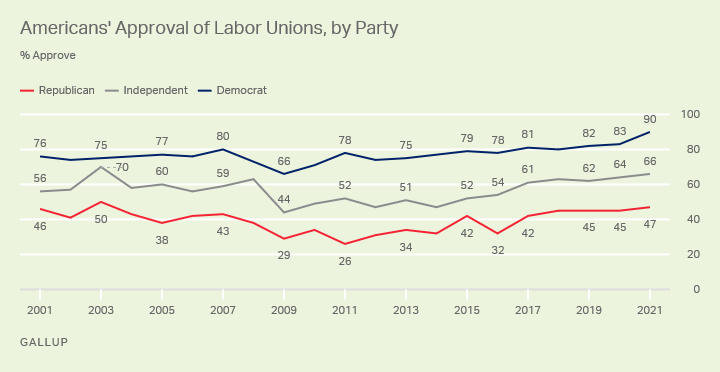
Keep an eye on union efforts in the tech industry. It's going to increasingly become a litmus test for companies looking to stay relevant. Union busting is the default operating mode here stateside. That much we know. But also, union busting has a pretty direct negative impact on consumer sentiment as long as people actually know it's happening. We also know that approval for worker's unions is rising and higher than it has been in years, with 68% of Americans approving of labor unions—90% of Democrats, 47% of Republicans, and 66% of Independents.
So hey, unionize your workplace. And as a part of your contract, require that workers play against management in team deathmatch in Quake and the winning team gets a pizza party. Or a pension.
Here's the Weather

More Stuff
- Comcast is planning to spin out NBCUniversal and Sky into their own companies, splitting their stock along the way
- After Pete Hegseth made Flu vaccines optional for military recruits, a Flu outbreak caused the military to reverse course after hundreds were infected
- SHOCKING! The extend of the damage to US bases around Iran is far more than previously reported by the administration
- Ford has rehired 350 long time engineers after previously laying them off in an AI pivot
- Some dudes in the UK used a bulldozer and a truck to rip an ATM out of a building and haul it away