Very Expensive Check Marks
The EU issued a fine to Twitter after a warning last July about Twitter's lack of transparency and verification

The European Commission has issued a €120,000,000 fine to Twitter ("X") in response to several claimed violations of EU policy.
The Commission holds that the changes Musk made to Twitter's "blue checkmark" verification system allowed for deception of users due to the lack of "meaningful verification."
If you live a normal life and don't follow the specifics on the history of verification systems on niche social media platforms, here's some more context:
Back in the day, Twitter had an issue of people impersonating public figure accounts. So, they added a process for verifying accounts of public figures and placed blue check marks on profiles that were verified to be legit.
Celebrities, journalists, politicians, and corporations were the biggest recipients of "blue checkmarks" on their profiles. Then, Musk accidentally bought Twitter.
Shortly after, he wholly changed how blue checks work, making it so anyone could purchase a blue check with a subscription. Chaos broke out for a while as people started making fake accounts and getting them "verified."
Twitter put out statements about the new checkmarks, but that is of course not going to undo the past decade-plus of a blue checkmark meaning "this profile can be trusted to be who they say they are."
So I mean, that was dumb. At the very least, they could have archived the use of a blue check and used a different color or symbol. They did that eventually with brand accounts, which get a different kind of check mark now since anyone could otherwise just buy a checkmark on an account called something like "@DisneyReal"
It's More than Check Marks
Beyond the Order of the Blue Checks lies a few more problems.
For one, Twitter's ad transparency is lacking. They're supposed to allow access to information about their ads marketplace to ensure transparency of who's paying for ads, but that information is just not available. Simultaneously, after buying Twitter, Musk shut out most public researchers from accessing the platform's data, which cuts at efforts to monitor stuff like hate speech, predatory behavior, and general online trends.
I wanna be clear though: this did not come out of nowhere. Twitter was alerted by the EU in July of 2024 about these exact issues. So this isn't really a sudden attack on US social media, as most of the Musk-aligned world seems keen to portray it.
All told, it's a pretty small fine for a company owned by the richest man on the face of the planet, but that hasn't stopped him from bitching about it, of course. More than just bitching, the man is calling for the end of the European Union over it, which is a healthy and normal response for a social media CTO.
The EU isn't my personal favorite institution either, but they are generally the only ones holding any tech companies accountable, even in a tiny capacity. Moreover, its their local legal system, and Twitter is a foreign entity operating for profit there, so uh, maybe if you want European money and users you can follow their very basic requirements for massive social platforms.
That Said, There's a Bigger Issue
Social media in the EU is fucky. People in the United States don't really have to think about this often, but around the world, people are often using social media platforms rooted in a foreign country. All that CHINA IS STEALING YOUR DATUMS applies just as much, if not more, to US tech companies.
There's a deep need for a restructuring. One country's inability to stop coked out losers from trying to control political narrative on the internet shouldn't bleed out into all other countries. We definitely shouldn't be in a place where US-based social media is used as a bargaining chip to circumvent foreign laws while operating in those countries.
My go-to tech nerd hot take about the internet is "it should be illegal to have a social media website with more than a few million users." That's a bit arbitrary for sure, but there is no reasonable way to safely manage users at the scale of national populations and beyond. The internet is decentralized by default. We don't need new technology (and certainly not crypto) to have a decentralized structure for social networks online, where no one company is hosting billions of accounts.
Federated social systems such as Mastodon (and to a lesser extent, Bluesky) allow for ad-free, community-centric online social networking. What they lack in the polished Fisher-Price-like streamlined experience of the massive tech companies, they make up for in respecting users and inverting the model to prevent something like a wildly rich man from buying and privatizing a social platform with hundreds of millions of accounts.
The European Commission already has its own Mastodon accounts, running on servers which are managed by the EU itself.
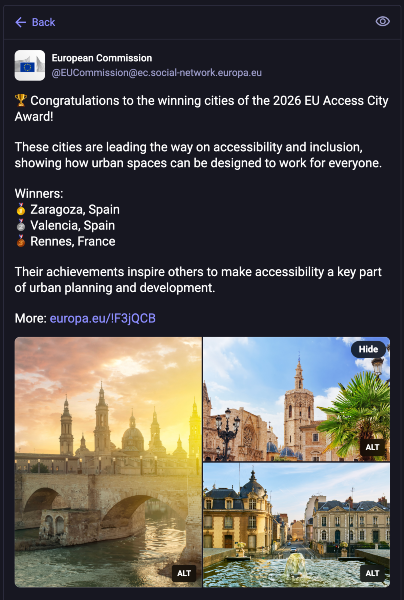
Instead of having all of our politicians shitposting on a commercial social media app, imagine if instead they had official social outlets with formally identifiable account names and servers to prevent any possibility of impersonation and reduce the centralized risk of a hacked account. Plus, you could then block entire governments or organizations on your timeline by just blocking their server. EZPZ.
But that'd… that'd make sense, unfortunately.
Long story short, the tech oligarchs have effectively built a walled garden, and they're mad at the concept of putting in a few windows.